


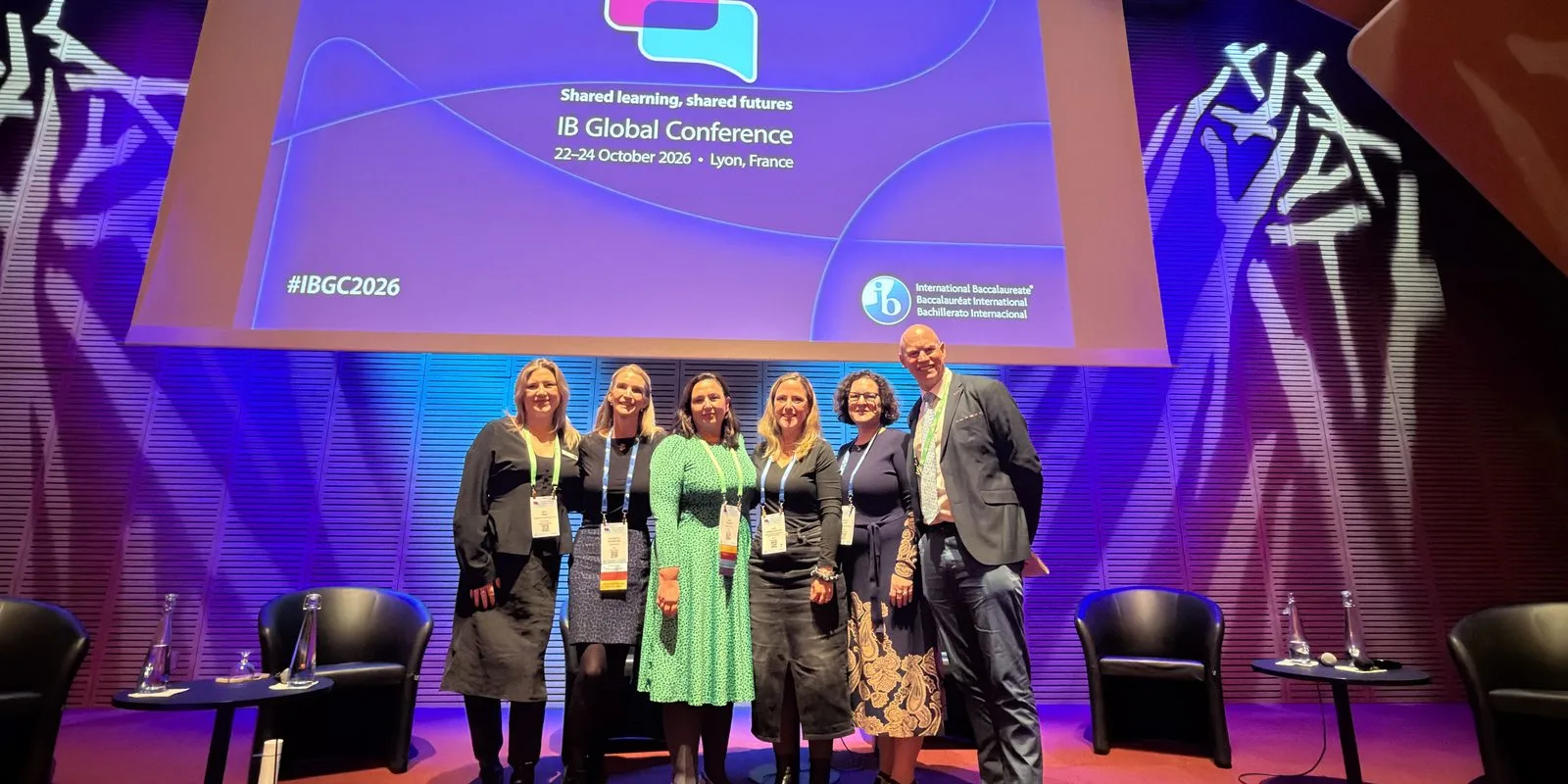
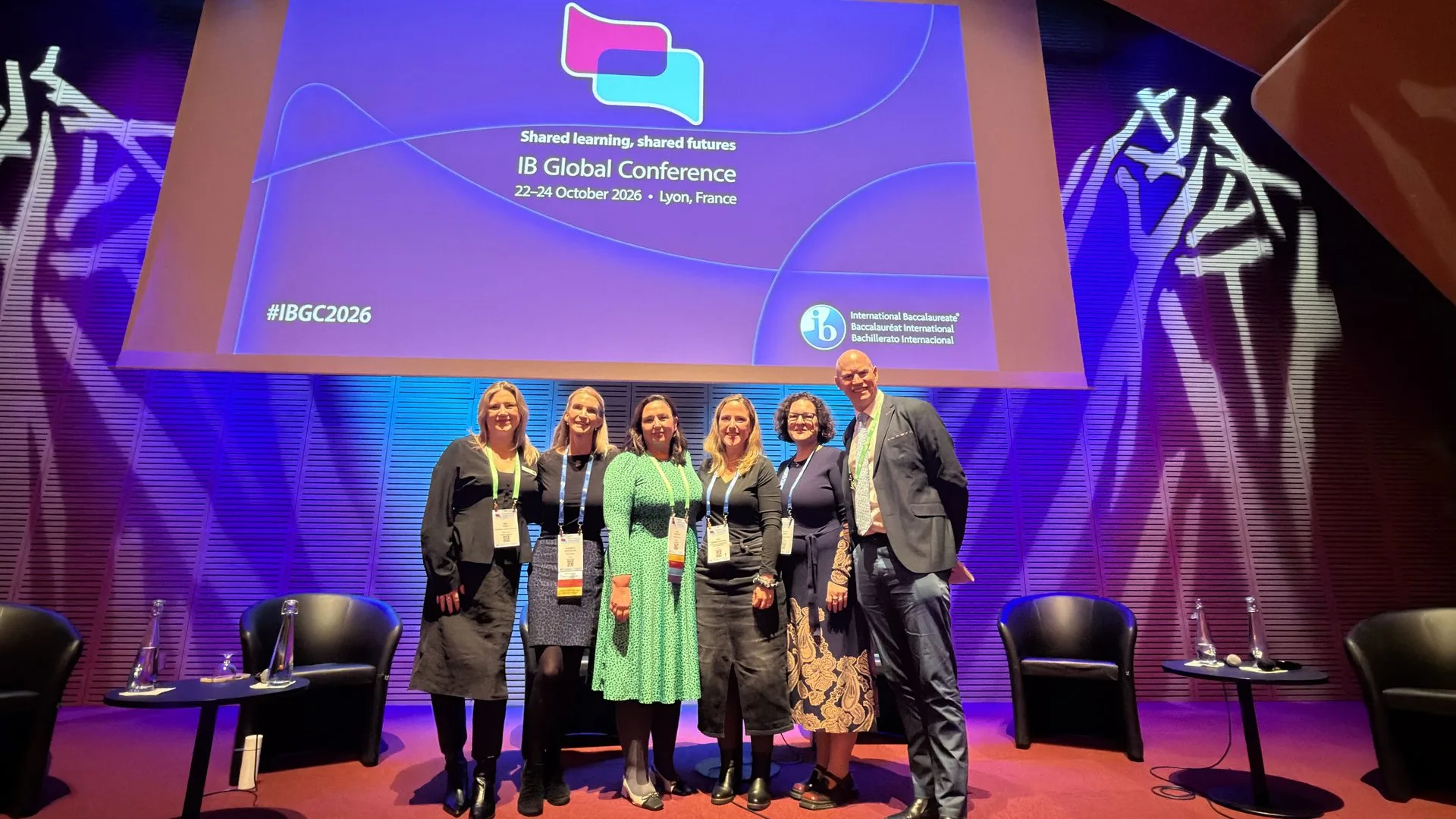
The AI panel at the IB Global Conference in Lyon, October 2026
Much of the worry about students and AI is about what they might be getting away with. Julia Campbell-Ratcliffe decided to ask her students what they were actually doing. What they showed her was more thoughtful than many adults would expect.
Julia is Head of Secondary at Strothoff International School in Germany. She spoke at the IB Global Conference in Lyon in October 2026, as one of four educators on a panel hosted by Faria Education Group about how their schools are handling AI.
Strothoff is a small IB continuum school, and Julia said its size helps. "It gives us the opportunity to really involve our students in the decision making and to really hear their voices," she said. "I think that's really important in the whole discussion about artificial intelligence."
Asking Students, Not Policing Them
Julia started with an anonymous survey asking students what they used AI for and how. She admits it's unusual for a principal to ask that question. Some students might worry they're about to be caught out as "the next academic integrity breaker."
So she was clear about why she was asking. "This is really for our faculty, for us to understand what you are using it for and how you're using it, and to really learn from you," she told them.
She also believes the adults have a lot to learn. Today's students are digital natives, and they pick up new tools quickly. For some teachers, she said, keeping up can feel daunting. "We have to be up to speed with that as well."
Once she knew what students used AI for, Julia asked to see their actual prompts. That's where the most useful insights came from.
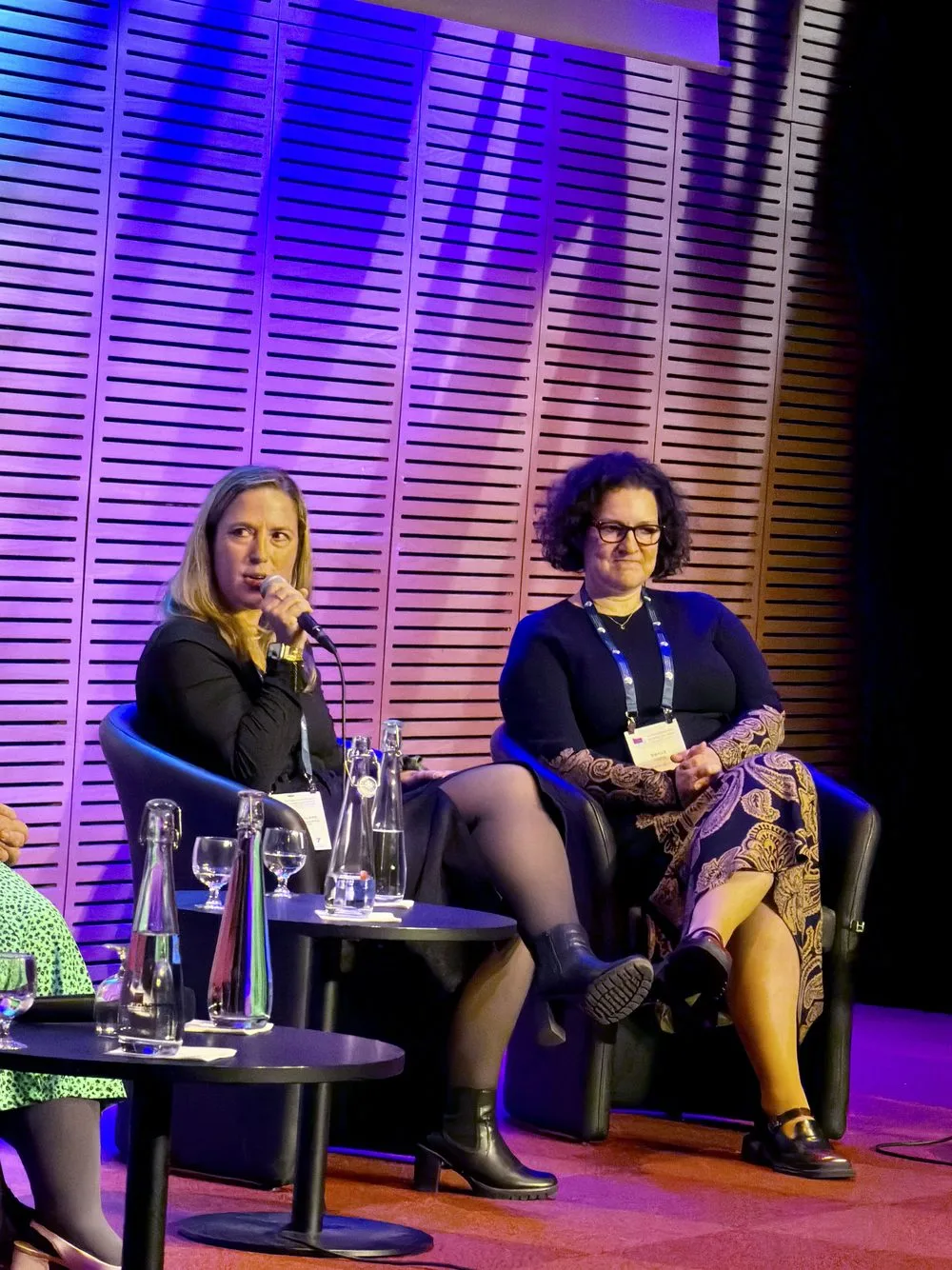
Julia Campbell-Ratcliffe (left) and Sibylle Harth on the panel
AI as a Thinking Partner
The prompts students shared showed many of them using AI as a dialogue partner. Instead of asking for answers, they had it probe their thinking. Here are some of the examples Julia shared.
Working through a math problem. A student working on 3D shapes and trigonometry opened a conversation in Gemini with a clear instruction: "Don't give me the answers. I want to actually get through this myself." The AI set out how the session would run and checked that the student was happy with that plan before starting.
Testing his own revision notes. Another student had already made his own color-coded learning sheets. He then asked AI to quiz him on the content and tell him how effective his sheets were, including what was missing. The AI was checking the student's work, not doing it for him.
Measuring writing against the rubric. Older students were giving AI their own writing along with the subject-specific rubric, and asking where they should elaborate more. Julia saw this as students co-constructing their own learning, using AI as a feedback tool against the same criteria their teachers use.
Second-Language Learners in Charge of Their Progress
Many Strothoff students start in German language acquisition classes and move into German language and literature once they're ready. That's a hard step up, because language and literature focuses on analysis rather than grammar.
Some of these students were giving AI their own writing and asking where their main grammar mistakes were and how they could improve their structure. Then they asked it to design practice activities aimed at those exact gaps. "Using it as a tool to develop more agency in their own journey," Julia said.
One MYP 5 student, who had moved from language acquisition into language and literature, used AI to improve a speech he had already written. He asked why and how he could make it better. The feedback covered both structure and grammar, and its probing questions helped him refine the speech before he gave it. He went on to deliver a strong presentation.
Julia teaches that class herself. She sometimes has to tell him the work doesn't have to be perfect, and that making the move into language and literature is impressive in itself.
For Julia, this fits the IB's aims. Continuum schools have a lot of students going through transitions like this, and "we want them to be autonomous, and we want them to be the owners of their learning."
Students Questioning Their Own Use
The survey also showed that students have concerns of their own, and they don't hold back about them. Julia said some of them surprised her.
Several students were worried that relying on AI might stop them developing as critical thinkers. Julia pointed out that asking whether AI is reducing your critical thinking is "a pretty critical analysis right there." She sees this metacognition as a reason for reassurance. Students who reflect on how they use AI are building critical thinking as they go.
She was also realistic. Students sometimes take the quick answer, "and that's okay." Part of the skill is deciding which tasks need real practice and which don't. Even so, she found it reassuring that "a lot of them are really thinking about using it responsibly."
A Blind Spot in AI Detection
Julia raised a specific warning for schools with many multilingual students. AI detection tools often flag work by second-language writers as AI-generated, even when the student wrote every word.
This happens because of the way these students structure their sentences, not because they used AI. Some of them take great care not to use it at all. "That's something to watch out for," Julia said, especially when a teacher suspects AI use and is tempted to rely on a detector to confirm it.
A Model with the Learner at the Center
Julia used AI to help her synthesize the survey responses into a model of how her students use AI, which she plans to share with staff and students. The learner sits at the center, and there are three ways students use AI around them:
-
Of learning: to understand and consolidate what they've learned
-
For learning: to design their own practice and learning activities
-
As learning: to reflect on how they learn, building metacognition
She originally described the model as "co-construction". After hearing the conference keynotes, she said she would now call it co-design, "because we're speaking about designing the learning."
The aim is the same throughout: to help students become the authors of their own learning. "It does not replace us as teachers, of course," Julia said. "But it empowers them to structure their own learning, and that's what they will have to do when they move on into the next phase of their education and as lifelong learners."
Strothoff has also worked with students to develop a set of AI scenarios based on IB principles. These show where AI use is fine and where it becomes a breach of academic integrity. Julia hopes they will reduce students' worry about getting it wrong.
What Students Can Teach Us
Julia's starting point was a survey, but the bigger change was in how she approached it. She asked students to show her how they use AI, instead of assuming the worst. What came back was a group of learners using AI to push themselves, to fill gaps in their own skills, and to question whether it was good for them.
Not every student uses AI this way, and Julia doesn't claim otherwise. But schools that only ask how to stop misuse may miss what their students are already doing well, and what the rest of the school could learn from it.
This post is part of a series from Faria's AI panel at the IB Global Conference in Lyon. Read the rest of the series by visiting our resource centre.
Connect with Julia here: linkedin.com/in/julia-campbell-ratcliffe-b604b487/J