


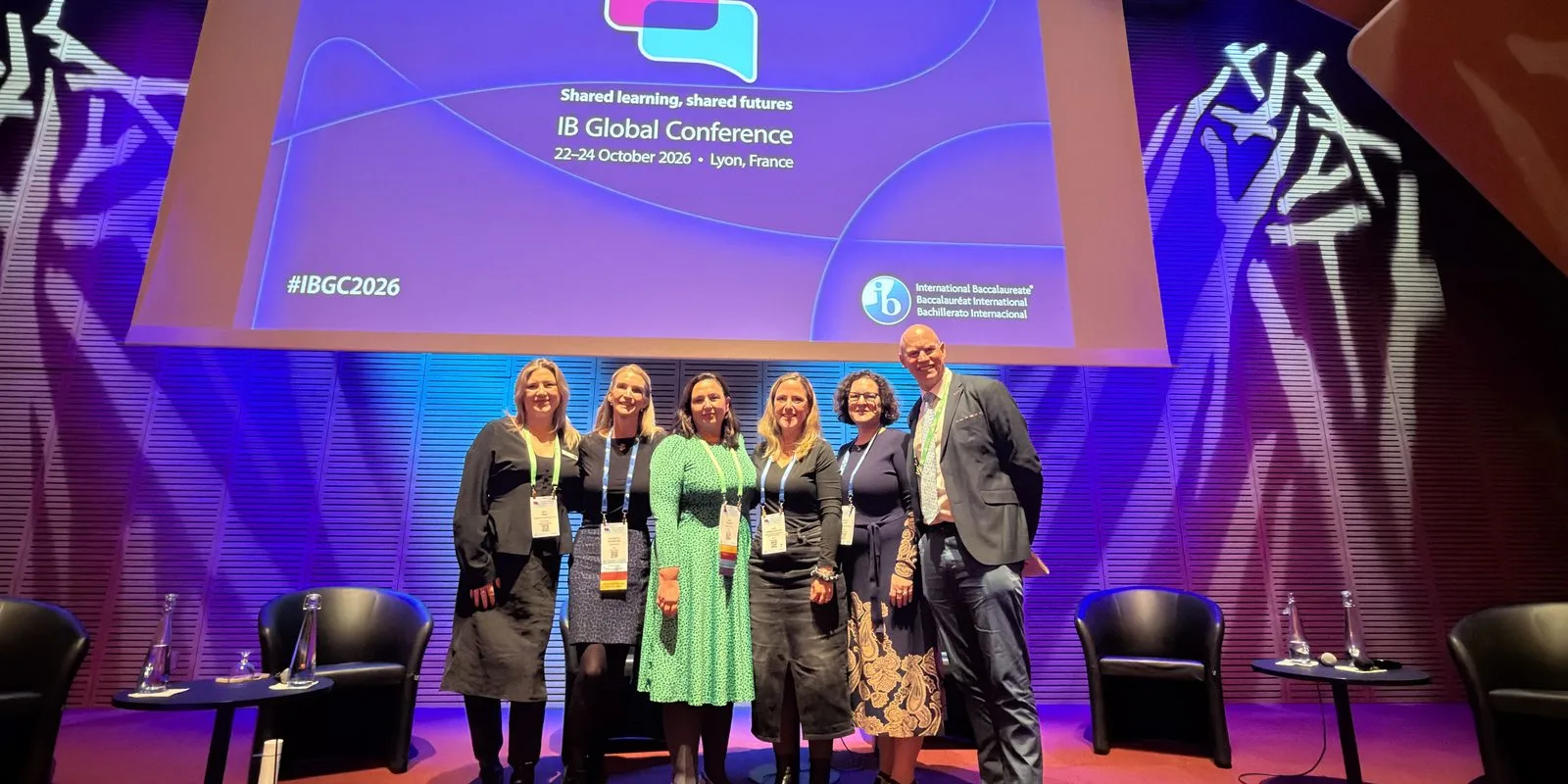
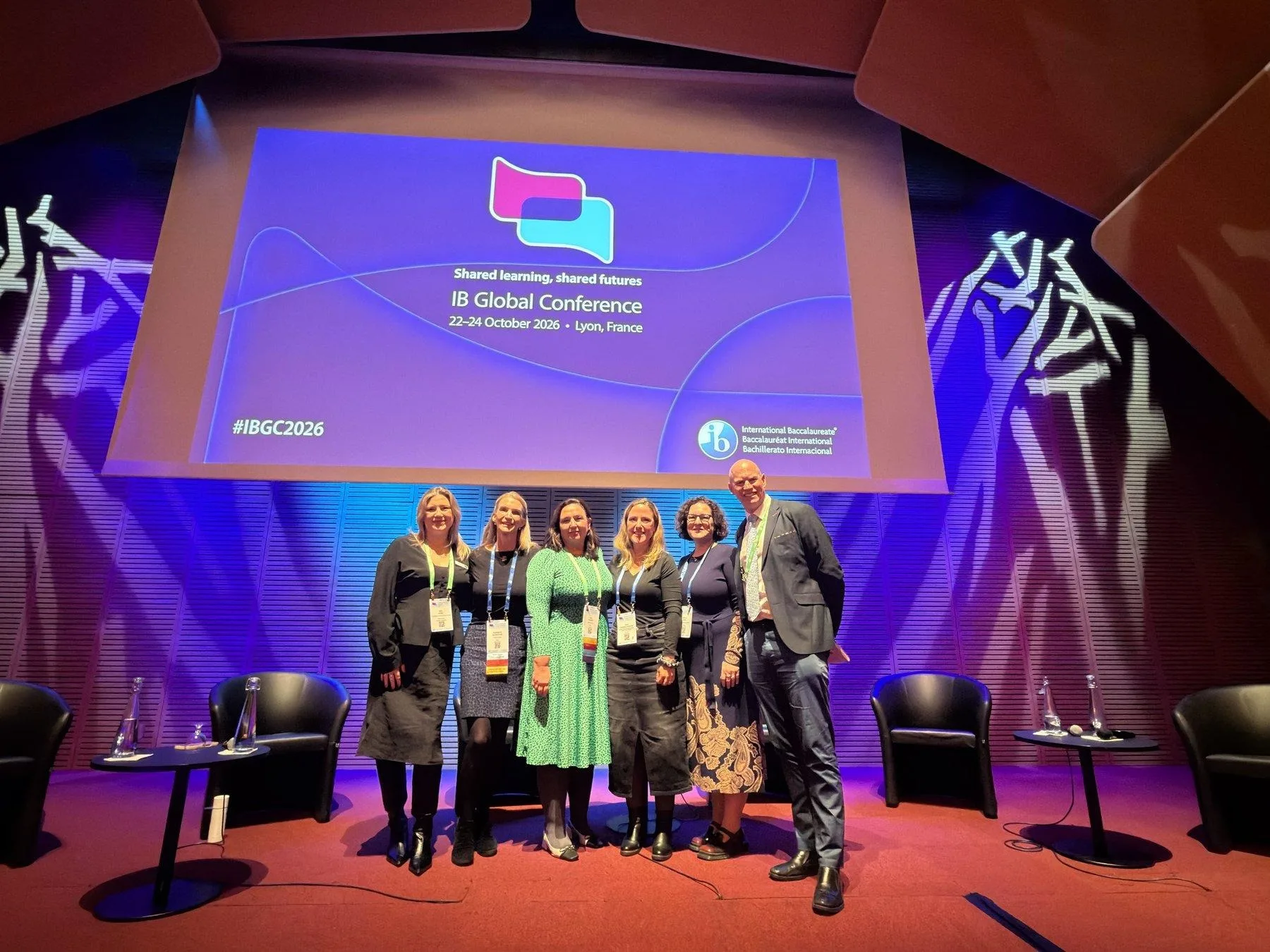
The AI panel at the IB Global Conference in Lyon, October 2026
One school's experience of AI can feel unique. Rita Bateson sees it across more than 100 schools, and what looks unique in one is often a pattern in many.
Rita is co-founder and director of Eblana Learning, which advises schools on ethical and sustainable use of AI and works in partnership with Faria Education Group. She was previously a senior curriculum manager at the IB. She joined three school leaders on Faria's AI panel at the IB Global Conference in Lyon in October 2026.
"The contribution I can bring to this panel is not individual, unique, authentic student voice," she said. "It's some non-obvious patterns." Through her work, she speaks with thousands of students, and some of what she hears is uncomfortable.
Patterns No Single School Can See
Rita described three trends she sees again and again in her work with schools.
-
The illusion of mastery. Some students use AI to build a personalized study plan, then work through a thousand practice questions it has generated. Those questions may not reflect what the IB actually asks, and there's no source of truth to check them against.
-
Internalized perfection. Other students compare their work with AI output, decide they can never reach that level, and stop trying. Seeing classmates use AI unethically and get better results can make that worse. "That creates rage within them," Rita said, "as only a teenager's heightened sense of injustice can."
-
Emotional extremes. Some students stay up until 2 a.m. vibe coding. Others won't touch AI until two minutes before a deadline, then feel bad about themselves for using it.
"When we think about what students are going through emotionally, as well as cognitively, it is fascinating," she said. Her advice to teachers is not to leave students to work through this alone. "You need to be with them in these ethical debates."
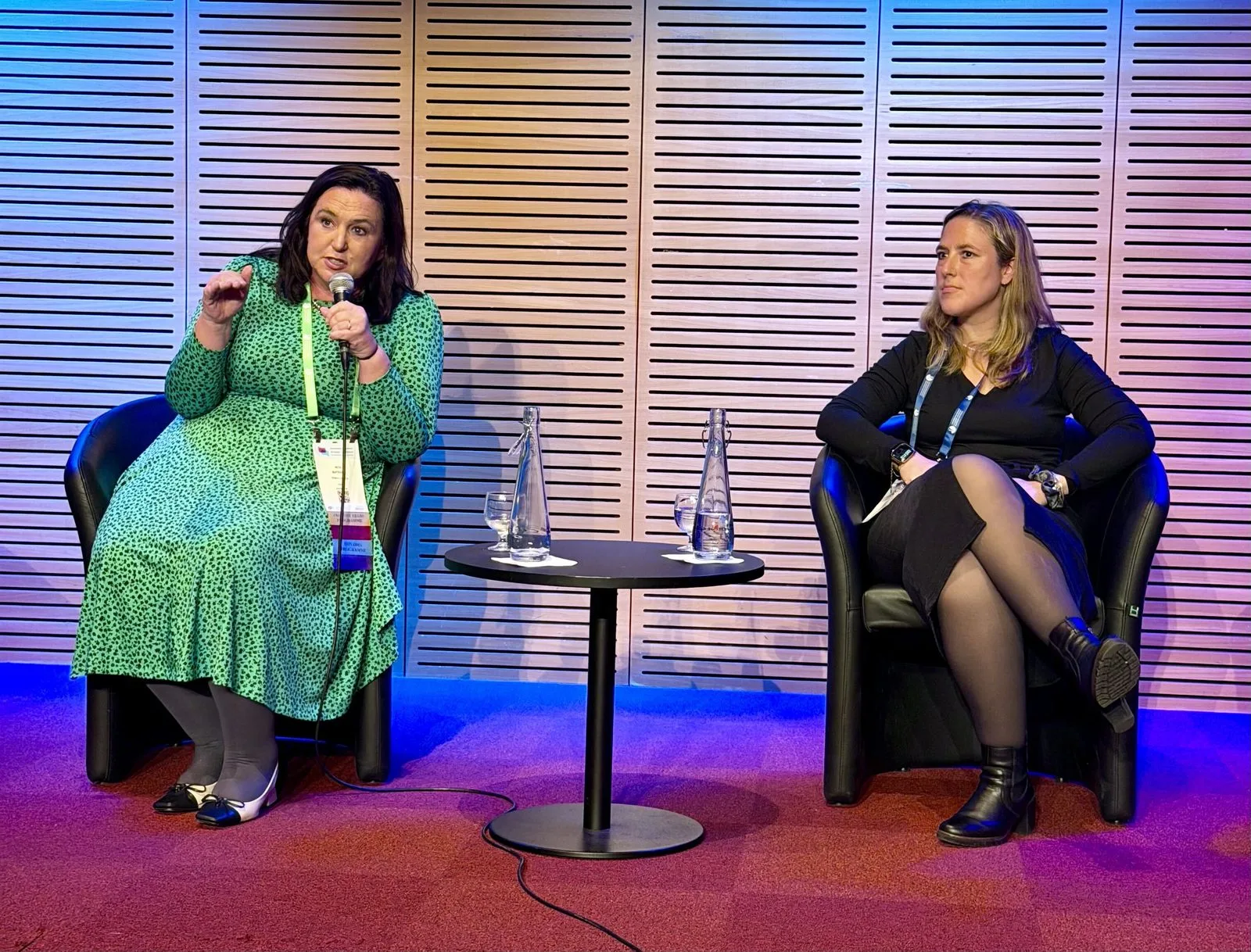
Rita Bateson (left) and Julia Campbell-Ratcliffe on the panel
The Guilt Students Don't Know What to Do With
Many students know about the environmental impact of AI, Rita said, but they don't know how to deal with it. They're not sure whether to feel guilty or to let themselves off the hook.
She lives with this issue at home in Ireland. Data centres used 23% of the country's metered electricity in 2025, according to the Central Statistics Office. Around Dublin the share is far higher: in Dublin and neighbouring County Meath, data centres use around half of all metered electricity, according to the think tank TASC. When the power cuts out, she said, she finds herself asking what all that energy is being used for.
Students notice the irony too. They tell Rita they're tired of "AI slop". They want reports that sound like them, and teachers who actually read what they hand in, even when they used AI to make it. Some complain about seeing the same AI-generated work in every classroom. "And I say, oh wow, is that like having a pile of essays that are all the same?" she said. That conversation, she added, is a valuable one to have.
From Good AI and Bad AI to a Risk Calculus
Students are happy to offload their thinking to AI, Rita said, and so are many teachers and school leaders. "This is an unlock that we've been promised for a very long time." She feels both cautious and excited about that.
She gave some examples of when AI is worth it:
-
Curriculum review. When MYP enhancements arrive, AI can put every old and new unit plan side by side and compare them in minutes. Rita knows from experience that this used to take a school about two years.
-
Policy review. AI can read 19 policies at once and show where they contradict each other, and which version is the current one.
-
Personal admin. She used AI to go through a thousand screenshots she had saved on her phone and pull out the websites and ideas she had meant to come back to.
And one example of when it isn't: generating 20 versions of the same logo, each with its own energy cost.
For students, the same thinking applies. AI that removes barriers to access is worth the energy. AI that builds a scaffold students fall apart without is, in her words, "a terrible use of AI." Rita wants students to learn to pause before they prompt.
"Too many students are just feeling good AI, bad AI. And we are much more nuanced than that."
Critical Discernment and the Read-Aloud Test
Rita argues that AI doesn't have to add to the curriculum, because IB schools already teach critical thinking. What students need now is critical discernment, along with examples of what excellent work looks like.
Students do sometimes check AI output for hallucinations. They check for bias less often, because they're not sure what to look for. Almost nobody checks it for mediocrity.
She has a simple fix for that last one: get students to read AI output out loud. "There's something about that processing moment," she said. Students who skimmed the text without noticing anything suddenly hear that it's boring or repetitive.
Bias Hides in the Defaults
Rita said bias "snuck in the back door" of some school reports last year. When AI doesn't have enough context, it falls back on stereotypes.
Ask it for a report on Tom and a report on Meg with no other information, and Tom comes out intelligent, dedicated, and capable. Meg comes out collaborative and caring. And in Rita's experience, if you ask it to describe the perfect student, it always describes a girl.
Personalization can make this worse. Two people asking the same question can get very different answers depending on what the model already knows about them. That's why Rita thinks students need to understand algorithmic manipulation more than they need excellent prompts.
Students and teachers both need to know about these biases, she said, and be ready to correct them.
Better Questions, Not Better Prompts
In the Q&A, a TOK teacher from Poland asked about a paradox. AI promises personalized learning, but personalization depends on a lot of context, and young students struggle to put that context into words. Should schools give students ready-made prompt libraries instead?
Rita's answer was no. Current models already pick up context from memory and past conversations, so writing long, detailed prompts has its own risks. Short, clear instructions are better, and they use less energy too. "Less is more with many of these models," she said.
What students really need are the classic skills: a wide vocabulary, critical thinking, and the confidence to step away from the screen. That includes being able to say no when an AI offers, "Would you like me to start that for you?"
As a textbook author, Rita said her biggest worry is that students won't build the skills to ask good questions. "Now answers are not valuable," she said. "Questions are valuable."
Start from Your Values
Rita ended by bringing it back to the IB mission statement. Her favorite line is that "other people, with their differences, can also be right." For her, that's the attitude schools need to bring to AI. "The student who wants to use it and the student who doesn't want to use it have to have a place in our school."
She pointed out that a lot is going on beneath the surface. Students run teacher feedback through AI detectors. One told her she had to "eat AI slop" because her mother now gets all her recipes from AI. And although students can seem to be ahead of adults, Rita said they aren't. Their use of AI is narrow but deep, and adults need a broader view: where students need protection, where they need inspiration, and when they can go outside a walled garden.
That starts with a school's own values:
-
If you believe in sustainability, are you acting that way with AI?
-
If you believe in differentiation or universal design for learning (UDL), are you using AI to support them?
-
Should AI be a tutor? Sometimes. But not in every case, "because what if it's only giving me the girl version of the truth, or the boy version of the truth?"
Rita also argued that data literacy, truth-seeking, and TOK have never mattered more. Students need to understand underlying patterns so they don't accept superficial results as truth, and adults need to model the same habits. Sometimes that means deciding a task isn't worth offloading. "Maybe slower is better."
Trusted Tools, Thoughtful Use
Rita's main point is that AI needs judgment, not a simple yes or no. Teachers can't be expected to research every risk themselves, so schools need trusted sources, trusted tools, and trusted environments. Trust, she said, now matters to a school's reputation as well as its legal position.
"We're the grown-ups. They're looking to us," she said. Keeping up is "really very, very challenging, but it's not impossible."
This post is part of a series from Faria's AI panel at the IB Global Conference in Lyon. Read the rest of the series: [Elizabeth Sutherland, Beacon School], [Sibylle Harth, International School of Düsseldorf], and [Julia Campbell-Ratcliffe, Strothoff International School]. Links to come.
[CTA to confirm]
Sources
-
Data centres accounted for 23% of all Ireland's electricity usage last year, new data shows, Irish Examiner, reporting Central Statistics Office data
-
Nearly 90% of Dublin's data centres are in economically disadvantaged areas, TASC, April 2026 (source for the Dublin and Meath figure, which TASC attributes to RTÉ)
This post is part of a series from Faria's AI panel at the IB Global Conference in Lyon. Read the rest of the series by visiting our resource centre.
Connect with Rita here: https://www.linkedin.com/in/rita-bateson-frsa-8741b868/