


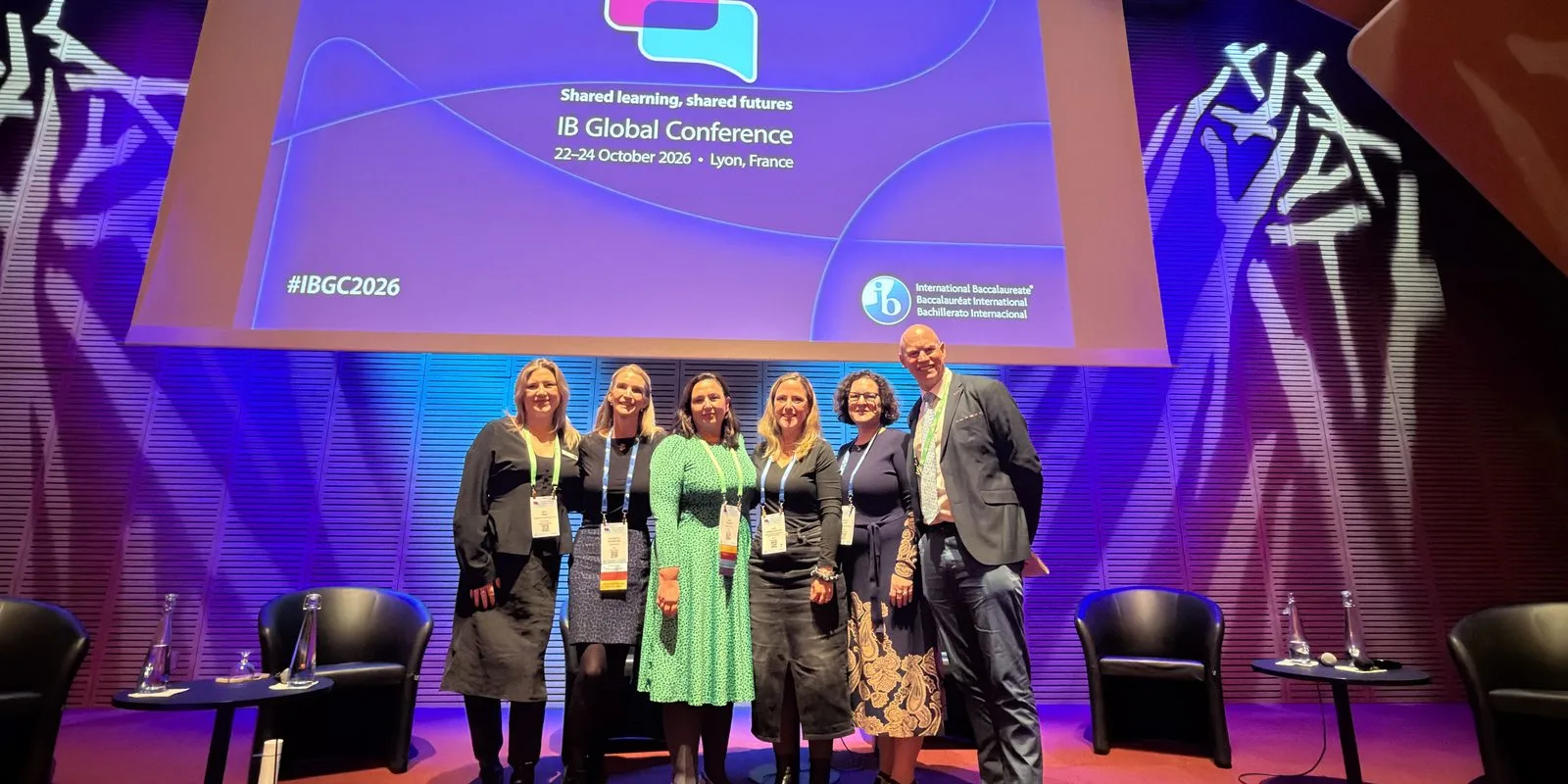
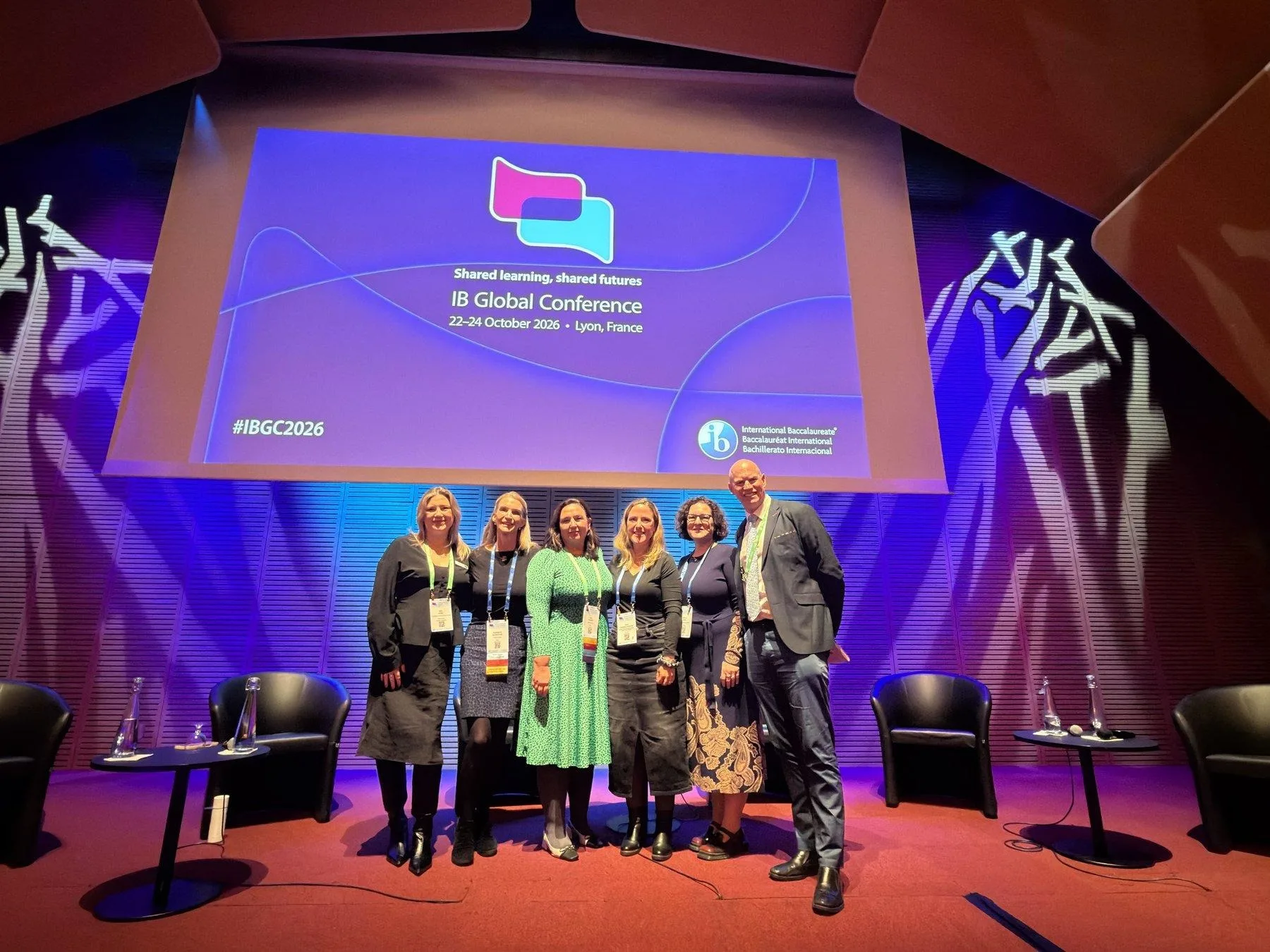
The AI panel at the IB Global Conference in Lyon, October 2026
Students can tell when a teacher used AI to plan a lesson. Parents can tell when a school email came straight from a chatbot. "I hope this email finds you well" is a giveaway, and so is an em dash ( — ).
For Elizabeth Sutherland, Head of School at Beacon School in São Paulo, Brazil, this is where any conversation about AI in schools has to begin. She spoke at the IB Global Conference in Lyon in October 2026, on a panel of four educators that Faria Education Group brought together to share how their schools are handling AI.
Beacon is an IB continuum school with around 1,600 students and 500 staff, and it's growing toward 1,850 students. Children join as soon as they can walk and stay until they're 18. "When we talk about AI, AI policies, and implications," Elizabeth said, "we really have to consider the whole range."
Modeling Starts with the Adults
Most schools give students some version of the same message. Don't use AI for this, don't use it for that, and if you do use it, tell us. Elizabeth puts the same question back to her own staff.
"Are you doing that? Are you modeling that yourselves? For me, this is where it all starts."
She sees a common pattern in how schools approach AI. First, they write an AI policy with input from staff, students, and parents. Next comes professional development, which usually covers what large language models are and how to write a prompt.
Most schools stop there. Few go on to build AI literacy and ethics among their teachers, yet they still expect students to pick those skills up. "We really need to be modeling that ourselves as adults," she said.
Report Season and the Easy Way Out
Report writing is where the gap between what schools say about AI and what they do shows most clearly. A teacher might have 200 or 300 reports to write, and AI is the obvious shortcut. When Elizabeth asked the room whether anyone had reviewed a report written entirely by AI, with no human in the loop, the answer was a loud yes.
She doesn't blame teachers for reaching for it. "What's the number one thing that teachers always want more of? Time," she said. "AI really is the go-to. It's the easy tool. And we shouldn't be limiting that, but we need to provide the guidance, the support, and the how."
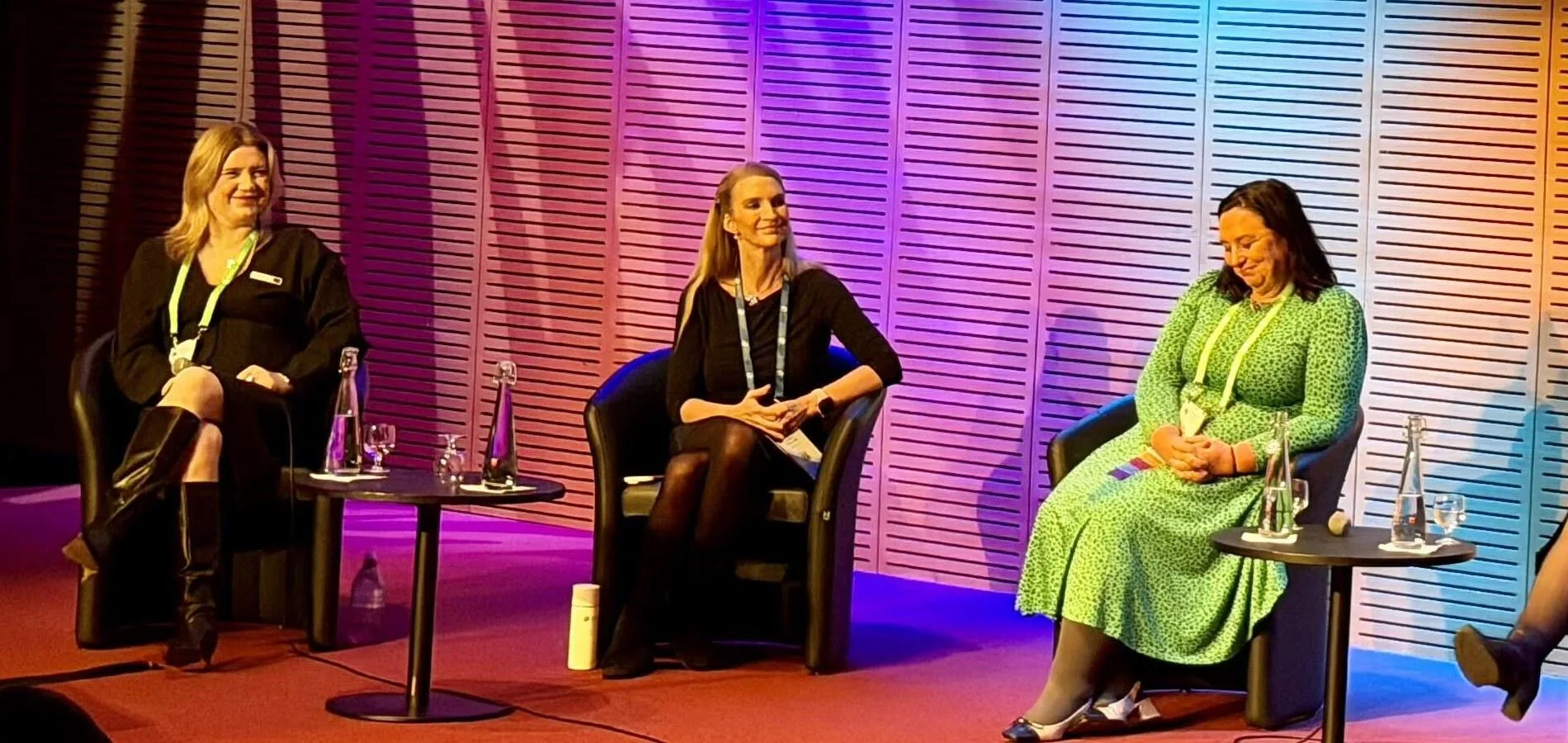
Elizabeth Sutherland (center) on the panel
Guidance Instead of Restriction
Beacon's answer is to say yes to AI for report writing, with conditions. The school gives teachers a structure, prompts, and guidance for using AI well. It also tells families in advance why and how teachers use it.
That second part matters. Beacon doesn't wait until reports go home. Parents hear about it in newsletters, at conferences, and again when reports are being written. Every report generated in ManageBac+ is under the statement:
"We use AI as a smart writing assistant to help organize the reports, but every piece of data and insight is 100% personalized by the teacher and backed by rigorous training on ethical and humanized use. AI is a tool for efficiency, but the teacher is always the author of insight."
According to Elizabeth, families across the school community have largely accepted the approach.
It Starts with Documenting Learning
Beacon's approach doesn't start at the point of writing. It starts with how teachers document learning while the unit is still running. This is a familiar topic for PYP and Early Years teachers, who already think a lot about how to evidence each child's learning through photos, observations, and ManageBac+.
Here's how it works at Beacon:
- Capture as you go. Each teacher keeps a simple spreadsheet for every unit of inquiry. It records ATL skills, evidence tied to learning outcomes, and direct quotes from students.
- Compile at the end of each unit. Teachers don't wait until the end of the semester. They run the evidence through a prompt the school provides, which turns it into a draft report specific to that child.
- Make it your own. The school prompt is a baseline. Teachers are free to write their own, and the insight in every report stays theirs.
- "So it's not having to do double or triple work," Elizabeth said. The evidence teachers collect for learning becomes the evidence for reporting.
The Parent Test
Elizabeth has also been on the receiving end of this process. Her daughter is a PYP student at Beacon, and she shared one of her daughter's reports with the audience.
"When I read the report, I said, yeah, that's my daughter. There was no question in my mind that the teachers knew my child, and that the evidence of learning was documented."
The report included her daughter's own words, taken from the quotes her teachers had recorded during the unit. "As a parent, I was really proud," Elizabeth said. "And I was happy to see that, even though I knew that AI was a big part of that process."
Let Students See You Struggle
During the Q&A, a TOK teacher asked how schools can build the habits that AI makes easy to skip. Elizabeth's answer went back to modeling.
The keynote that morning had made the point that students now expect instant answers. Elizabeth said adults do too: "If I want to know the best restaurant around Lyon, I search for it, and boom. I expect it in one second."
She argued that students should sometimes see their teachers struggle, "but struggle in a healthy way," instead of always going straight to a quick, polished answer. "It's really important for students to see that sometimes we need time. We need to work through things together. We need to come to conclusions about truth, and how we arrived there."
The Teacher Stays the Author
Beacon's approach doesn't hide AI and doesn't ban it. Teachers are trained to use it well, parents know how it's used, and the evidence comes from the classroom, so the AI has real learning to work from. Students see adults using AI openly and responsibly, which is what schools are asking of them.
"We adults need to be the role models in the process," Elizabeth said, "because the students are also seeing this, and they're learning from us."
This post is part of a series from Faria's AI panel at the IB Global Conference in Lyon. Read the rest of the series by visiting our resource centre.
Connect with Elizabeth here: https://www.linkedin.com/in/elizabeth-sutherland-946862203/